Quick sizing rule
Measure the room that will contain the purifier, not the apartment’s total listing size. For an 8-foot ceiling, ENERGY STAR’s current table pairs 100 square feet with a minimum CADR of 65 cfm, 200 square feet with 130 cfm, and 300 square feet with 195 cfm. That is approximately:
Minimum CADR in cfm = room area in square feet × 0.65
Choose more capacity for higher ceilings, open connections to other rooms, heavy particle sources or operation at a quieter lower speed. Confirm the smoke CADR or the pollutant-specific CADR rather than relying on a large marketing coverage number with unclear assumptions.
No purifier was supplied for laboratory or home testing. This guide uses current EPA and ENERGY STAR information reviewed July 5, 2026.
What CADR tells you
Clean Air Delivery Rate combines airflow and particle-removal performance into one number for the complete unit. Higher CADR means the purifier supplies clean air faster and can serve a larger room.
CADR may be reported separately for smoke, dust and pollen. Smoke CADR is commonly used as the conservative sizing reference for smaller particles. A filter label alone does not tell you how much cleaned air the assembled machine delivers.
ENERGY STAR apartment sizing table
| Room area | Minimum CADR | Example room |
|---|---|---|
| 100 sq. ft. | 65 cfm | Small bedroom or office |
| 200 sq. ft. | 130 cfm | Medium bedroom |
| 300 sq. ft. | 195 cfm | Small living room |
| 400 sq. ft. | 260 cfm | Larger living area |
| 500 sq. ft. | 325 cfm | Large open room |
| 600 sq. ft. | 390 cfm | Large open-plan zone |
The ENERGY STAR chart assumes an 8-foot ceiling. For a 10-foot ceiling, multiply the table result by 10/8, or 1.25, as a practical volume adjustment.
Why advertised coverage can mislead
Manufacturers may calculate coverage at different air-change rates. One model can advertise a very large area when the assumed cleaning frequency is low. Another may show a smaller area at a more demanding air-change rate.
CADR offers a more consistent comparison. Look for an independently verified value and check the ENERGY STAR Product Finder or AHAM directory where applicable.
One purifier does not clean through walls well
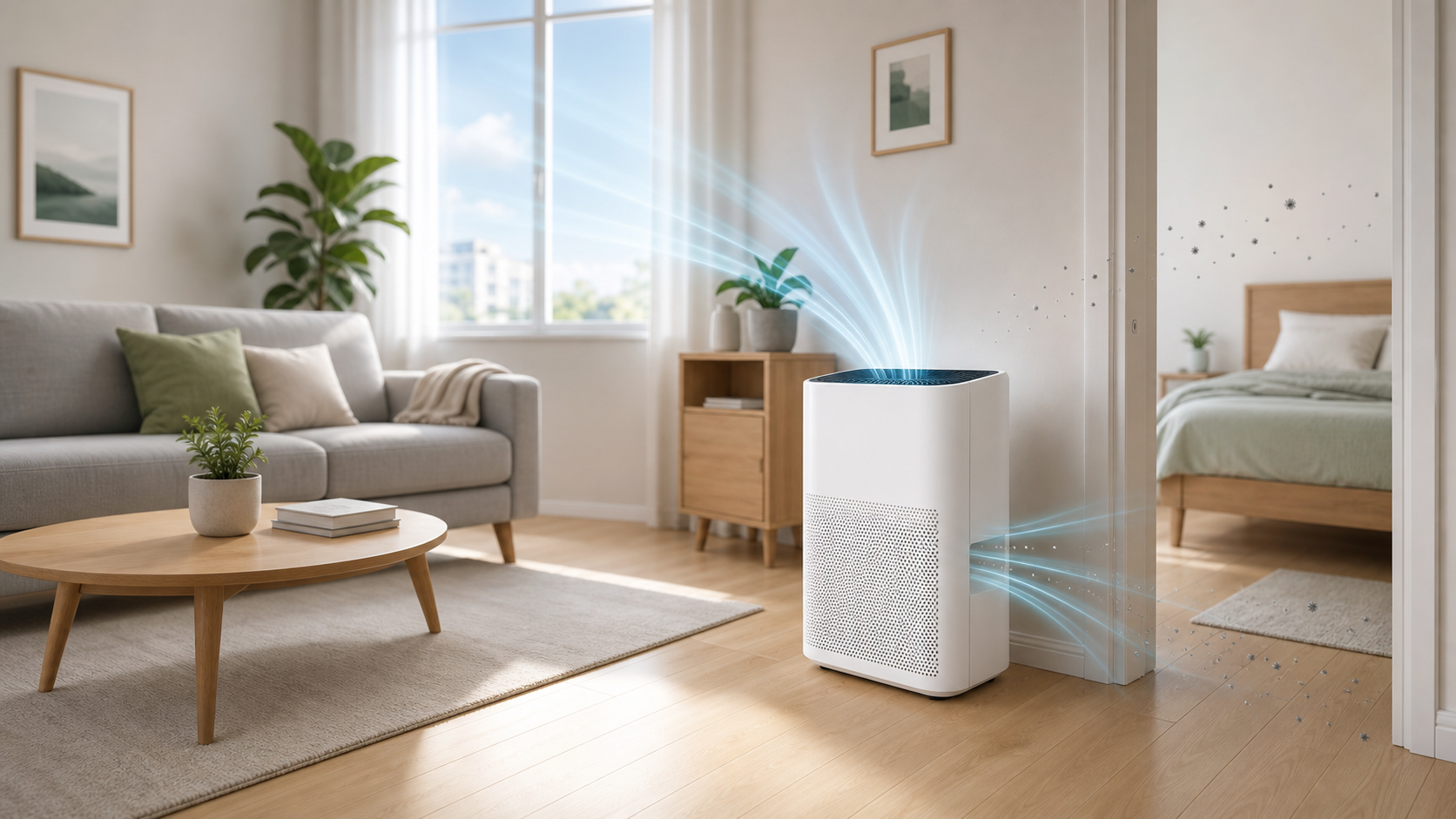
Portable air cleaners are intended for one room or area. Closed doors, hallways and furniture interrupt air mixing. A purifier in the living room should not be assumed to provide the same particle removal in a closed bedroom.
For a small apartment, prioritize the room where a person spends the most time. Moving one unit between rooms is possible, but it only cleans effectively while it is running with unobstructed airflow in that room.
Source control comes first
EPA recommends reducing or removing pollution sources and ventilating with clean outdoor air where practical. A purifier cannot fix carbon monoxide, a gas leak, active smoking indoors, a dirty combustion appliance, a water leak or mold growing in building materials.
Particle filters are not the same as gas filters. Activated carbon or other sorbent media may help with some odors and gases, but performance depends on the amount and design of the media. A thin carbon sheet should not be treated as universal chemical protection.
HEPA, CADR and filter terminology
HEPA describes a filter-efficiency standard; CADR describes the cleaned-air output of the complete product. A well-sealed HEPA purifier can be useful, but buyers should still compare CADR, noise and replacement-filter cost.
Avoid products that intentionally generate ozone in occupied spaces. EPA states that ozone is a lung irritant and is generally ineffective at safe concentrations for controlling indoor air pollution.
Noise: size for the speed you will tolerate
Maximum CADR is often measured at the highest fan speed, which may be too loud for sleep or calls. Compare noise data by fan setting and consider a larger unit operated at medium speed.
Placement matters. Keep the intake and outlet away from curtains, walls and furniture according to the manual. Do not place the purifier where a child or pet can tip it or pull the cord.
Total cost of ownership
Calculate annual filter cost from the official replacement interval and current filter price. Real interval varies with smoke, dust, pets and hours of operation. Check whether the unit uses one filter or several separate parts.
ENERGY STAR reports that certified room air cleaners are more than 50% more energy-efficient than standard models under its current program assumptions. Compare the Integrated Energy Factor or CADR-to-watt information when two units have similar performance.
Buyer decision table
| Priority | Look for | Watch out for |
|---|---|---|
| Bedroom | Adequate CADR at a quiet speed, dimmable lights | Only maximum-speed performance shown |
| Cooking particles | Higher smoke CADR, washable prefilter | Claims that ignore ventilation and source control |
| Pets | Accessible prefilter, replacement availability | Treating airborne filtration as floor cleaning |
| Wildfire smoke | High smoke CADR and good sealing | Opening windows when outdoor air is hazardous |
| Odors or gases | Substantial, documented sorbent media | Thin carbon sheet marketed as complete gas removal |
Before-buying checklist
- Measure the main room and ceiling height.
- Calculate minimum CADR and add headroom if needed.
- Verify smoke, dust and pollen CADR.
- Check noise at the intended operating speed.
- Price genuine replacement filters for one year.
- Confirm dimensions and airflow clearance.
- Review ozone and ionizer settings.
- Check warranty, certification and recall status.
- Decide which room gets priority.
Final recommendation
For an apartment bedroom or living room, buy by verified CADR and realistic operating noise. A unit that technically fits the room only at an intolerable maximum speed is undersized in practice. Choose enough headroom to run comfortably, budget for replacement filters and treat the purifier as a supplement to source control and appropriate ventilation.
Sources and methodology
- ENERGY STAR room air-cleaner sizing and efficiency
- EPA Guide to Air Cleaners in the Home
- EPA air-cleaner selection guidance
GameFunns did not measure a purifier’s CADR, noise or filter life. This guide does not make a medical-outcome claim or recommend one brand.